Discover the good Apps to customize your Android and provide safe APK to download.
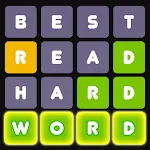
Developed by Lion Studios Plus, Wordle! was the smartphone version of the global phenomenon of word guessing, capitalizing on the global craze of the original web-based Wordle by Josh Wardle. Released in 2016 but re-released in 2022 due to the popularity of its namesake, Wordle! combines classic crossword mechanics and modern social integration, turning it into a habit-forming experience for word enthusiasts.
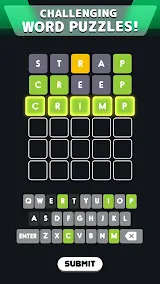
The fundamental mechanic of the game is based on a 5x6 grid, on which players solve a concealed five-letter word within six chances. Each attempt prompts color-coded results: gray for misplaced letters, yellow for out-of-position letters, and green for correct ones. The scheme, though easy to understand, requires strategic intelligence, as players need to eliminate options based on hints — a task that feels very much like completing a linguistic Sudoku puzzle.
Wordle! excels with a few game modes. The “Guess in 6” mode simulates the classic Wordle’s daily puzzle, while “Secret Word” offers unlimited time but limits players to three failed attempts per game. Thrill lovers will enjoy the “Timed Challenge” mode that pressures players to solve words before a timer expires, rewarding swiftness and accuracy. Including longer-word puzzles (i.e., 7-letter words) adds further layers of complexity, which will satisfy veterans seeking tougher tests. Social sharing is a standout feature as well. Players share results using emoji grids, fostering friendly competition — a feature that contributed to Wordle’s virality on media platforms like Twitter.
Wordle! is a great portable, full-featured take on the word-guessing genre that succeeds, but its copycat design and ad-dependent existence hold it back from truly hitting its stride. For puzzle fans who crave a daily challenge, it serves the purpose — but Lion Studios Plus must move beyond copying to stay relevant.
Generally speaking, Wordle!’s performance in the app market is more than satisfactory. First of all, Wordle! has gotten more than 772.4K reviews and a 4.6-star rating in the Apple App Store. In contrast, the app’s performance in the Google Play Store is slightly more mediocre, experiencing more than 10 million installs, Wordle! received more than 161K reviews and 4.1 stars.
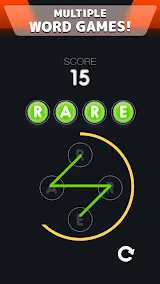
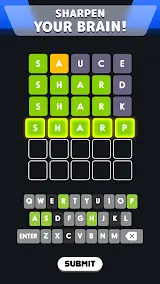
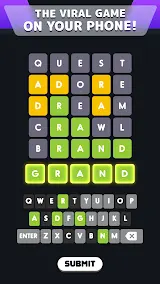
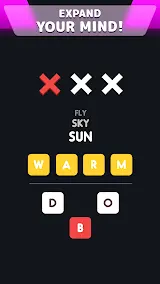
In a recent update, the developers behind Wordle! have focused on optimizing its runtime performance, as well as tweaking and fixing its recent bugs.
During my inaugural week with the app, I was especially in love with the Theme Challenges, completing the “World Cuisine” pack that had words about cuisine like “SPICE,” “BASTE,” and the somewhat surprisingly difficult “UMAMI.” The pre-puzzle contextual clues — subtle hints about the theme without revealing too much — added an extra level of inference beyond simple letter-pattern recognition. The haptic feedback for correctly positioning letters was satisfying tactile feedback, and the incremental animation of tiles rotating created anticipatory moments lacking in less sophisticated implementations. Solving around fifty puzzles in different modes, I then began noticing patterns in the word selection algorithm that occasionally made solutions predictable, particularly when some of the less common letters appeared early on in my attempts.
Pros
1. The color-coded grid makes guesswork a deductive puzzle with obvious, actionable clues.
2. From timed dashes to relaxed “Secret Word” gatherings, the game accommodates all play styles.
3. Longer words (7+ letters) and expert modes test vocabulary and pattern recognition.
4. Emoji grids enable bragging rights without spoilers, enabling community interaction.
5. Rotating puzzles prevent stagnation, encouraging habitual play.
6. Clean UI resists clutter, keeping word-solving in focus.
7. No internet connection after install, ideal for commutes.
Cons
1. Periodic, non-skippable ads break flow, particularly after losses.
2. Limited word banks lead to repeated puzzles over time.
3. Locally stored progress may be lost during device changes.
4. Social features are passive; there is no real-time competition.
5. Abrupt, sudden spikes in word difficulty (e.g., obscure words like “XYLOL”) enrage casual players.
 Check All Versions
More Like This
More >>


Additional App Information
-
Category:Word Games
-
Update:3 Jul,2024
-
Size:101 MB
-
Requirements:Android 5.0+
-
Developers:
Discover Apps



Top Downloads
-
 Coin MasterCasual Games4.6

-
RobloxAdventure Games4.4
-
FishdomPuzzle Games4.5
-
Pokémon GOAdventure Games4.3
-
Clash of ClansStrategy Games4.6
-
Lords Mobile: Tower DefenseStrategy Games4.4
-
TownshipCasual Games4.6
-
Top War: Battle GameStrategy Games3.1
-
HomescapesCasual Games4.7
-
Subway SurfersArcade Games4.6