Discover the good Apps to customize your Android and provide safe APK to download.
Snapchat, developed by Snap Inc., is perhaps the most distinctive social media platform in today’s online reality. Since 2011, the application has evolved from a simple photo-sharing site into a complete communications system that redefines the way people communicate, share, and interact with content. With more than 850 million monthly active users currently, Snapchat has well and truly established itself as a social media giant, especially among Generation Z users who love its focus on real interactions. The very basic innovation of the platform — disappearing content after being seen — brought a paradigm shift in online communication, focusing on moment-by-moment sharing rather than lasting digital footprints.
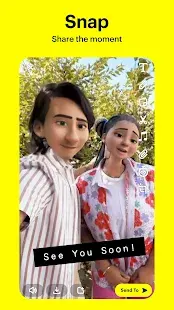
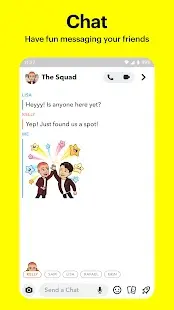
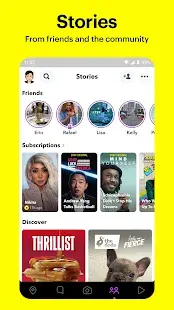
The technical design of Snapchat also contains many interwoven features that create a stable user interface. It is built around “Snaps” itself — images or videos enhanced by creative processes like filters, lenses, captions, and stickers — that can either be sent straight to friends or uploaded in one’s “Story” to view for 24 hours. Their temporary nature mirrors such everyday action where conversation remains out there available but never actually filed away in long-term memory. The Chat feature enables text messaging and video calling between users, offering a rich-featured communication channel beyond visual content. Meanwhile, Snapchat’s Discover platform curates content from media partners and creators, making the app a content consumption destination alongside its social networking features.
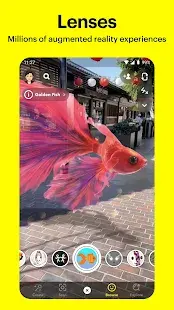
Snapchat has pioneered advanced augmented reality (AR) technology far beyond simple photo filters. Its advanced AR lens allow users to transform their look, manipulate virtual objects, or drop virtual entities into the real world with smartphone cameras. Its capability to combine entertainment and everyday use, allowing such functions as virtual try-on of apparel, accessories, and cosmetics for instance, opens up new opportunities in blending e-commerce. The integration with Bitmoji also individualizes the experience, enabling users to design their own cartoon avatars that become present everywhere in the app, which is another level of self-expression.
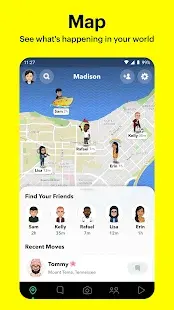
The platform’s geography is a testament to its intention to connect online activity with offline experience. Snap Map indicates the whereabouts and activities of friends if they opt to share, resulting in spontaneous meetups and physical interactions. This spatial feature is an indication of Snapchat’s acknowledgment that real social experiences can transcend purely online interactions. Additionally, Snapchat’s Spotlight enables viral content from across the platform to be accessed, enabling creators to reach more users while entertaining those browsing casually.
On the whole, Snapchat’s performance in the app market is impressive. For starters, Snapchat has gotten over 3.7 million reviews and a 4.7-star rating in the Apple App Store. At the same time, it ranks fifth on the list of top Photo & Video category apps. Not only that, but the app also performs remarkably well in the Google Play Store, where after experiencing more than 1 billion installs, Snapchat has gotten more than 37.1 million reviews and 4.3 stars.


In a recent update, Snapchat received fixes for bugs that appeared in its operation as well as overall performance improvements.
After using Snapchat extensively for over a week, I have come to appreciate several of its small details that distinguish it from other social networking platforms. I now have it as a daily routine to look at my Snap Map and check whether friends are near me and share moments of my day with the newest AR filters. One particularly night, I attended an art exhibition and used a custom geofilter that applied abstract shapes and vibrant color gradations on top of my photographs, accurately replicating the evening’s artistic environment. Swiping through a variety of lenses felt like being a part of a continuously evolving interactive artwork.
Pros
1. Snapchat innovates constantly with augmented reality, offering a vast spectrum of engaging lenses that enable individuals to alter their appearance and surroundings.
2. The temporary nature of snaps encourages impulsiveness. Knowing the messages will vanish once they’re opened, less pressure is felt to create perfect content and more honest, live conversations.
3. Snap Map feature offers an interactive image of friends in close vicinity and activity in the surrounding area, taking ordinary social interactions and turning them into possible in-real-life meeting opportunities.
4. Snapchat’s Stories allow a user to organize a series of snaps in chronological order, as a coherent narrative.
Cons
1. It can be confusing for new users, due to the special interface and swiping controls.
2. With snaps so fleeting in nature, aside from when the user manually saves things, important moments are lost forever.
3. Extensive use of camera capabilities and AR filters has significant effects on battery life, particularly for older smartphones.
 Check All Versions
More Like This
More >>






-
 By I miss SnapchatOk l love it4 Nov,2023
 -
By K@sey brookingI wanna log in Snapchat21 Sep,2023
-
By VioletLove snapchat24 Apr,2023
-
By JackieExcellent28 Oct,2022
-
By Inger-Lise O'ConnorWonderful Snapchat8 Sep,2022
Additional App Information
-
Category:Social
-
Update:4 May,2023
-
Size:216 KB
-
Requirements:Android 4.4+
-
Developers:
Discover Apps






Top Downloads
-
WhatsApp MessengerCommunication4.3


-
TelegramCommunication4.3
-
Bigo Live - Live Streaming AppSocial4.4
-
Google Play StoreTools5.0
-
YouTubeVideo Players & Editors4.2
-
Walmart Shopping & GroceryShopping4.7
-
Discord: Talk, Chat & Hang OutCommunication4.5
-
WEBTOONComics4.8
-
MeetMe: Chat & Meet New PeopleSocial3.4
-
Tango – Live Streams & Live Video Chats: Go LiveSocial4.5